I am Death, the destroyer of worlds
Bhagavad GitaThe expression “I am Death, the destroyer of the worlds” is the decisive utterance of Krishna’s Vishvarupa Revelation. It turns the battlefield of Kurukshetra from a human crisis into a cosmic disclosure: the warriors’ destruction is not presented as an outcome dependent solely on Arjuna’s choice, but as an event already encompassed by Krishna’s universal power. Arjuna is therefore commanded to rise, fight, and accept the narrower but still consequential role of instrument.
The Battlefield Crisis
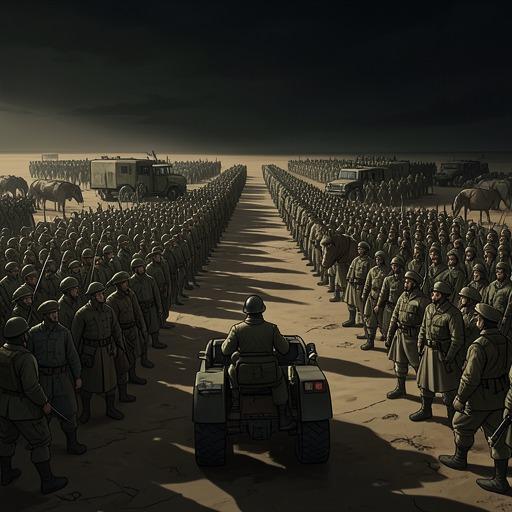
The expression emerges from the Bhagavad Gita, the “divine song” embedded in the Mahabharata. The work takes the form of a dialogue between Krishna and Arjuna on the battlefield of Kurukshetra, where spiritual instruction is delivered inside an immediate political and military emergency rather than in isolation from worldly life. Arjuna first asks Krishna to place his chariot between the two armies so that he may see those with whom he must contend.
That request produces a crisis of recognition. Looking across the armies, Arjuna sees teachers, fathers, sons, grandfathers, in-laws, friends, and other kinsmen. His physical reactions register the collapse of his martial confidence: his limbs become languid, his mouth dries, his body trembles, his hair stands on end, his skin burns, and his bow Gandiva slips from his hand. Victory, sovereignty, pleasure, and even life lose their value because the people for whose sake they might be desired are standing before him ready to die.
From Moral Refusal to Cosmic Vision
Arjuna’s refusal is not simple cowardice. He argues that killing Bhishma and Drona, whom he regards as worthy of worship, would make any resulting pleasure bloodstained. He fears the destruction of families, the loss of inherited customs, the rise of sin, the corruption of women, the intermingling of social orders, and the cessation of rites owed to ancestors. Even an unresisting death at the hands of the sons of Dhritarashtra seems preferable to killing his own relatives for the sake of sovereignty.
He finally declares that his nature is overwhelmed by compassion and that his mind is uncertain about duty. Arjuna asks Krishna to instruct him as a disciple and confesses that no earthly kingdom, nor even the sovereignty of the gods, would dispel his grief. After saying that he will not fight, he falls silent. Krishna’s teaching begins precisely at this impasse, where family loyalty, inherited duty, fear of sin, and the demands of battle appear irreconcilable.
Krishna initially answers by distinguishing the immortal soul from its perishable embodiment. The embodied soul is described as unborn, eternal, unchangeable, and indestructible; weapons cannot cleave it, fire cannot consume it, water cannot drench it, and wind cannot dry it. As a person casts off worn-out garments and puts on new ones, the embodied soul casts off worn-out bodies and enters others. Even on the more ordinary assumption that beings are born and die, Krishna argues that death follows birth and birth follows death, so grief cannot alter an unavoidable process.
The Meaning of the Declaration
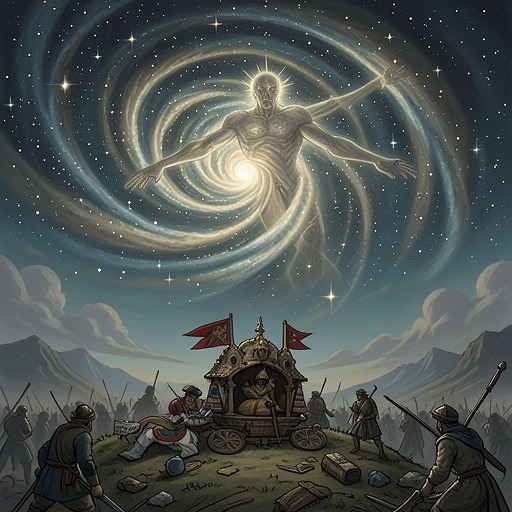
Within the Vishvarupa Revelation, however, death is no longer treated only as a philosophical necessity. Arjuna sees Krishna’s terrible universal form, with blazing radiance, many colors, enormous fiery eyes, and mouths made fearsome by tusks. The vision destroys ordinary scale. The sons of Dhritarashtra, hosts of kings, Bhishma, Drona, Karna, and principal warriors from Arjuna’s own side rush into those mouths; some strike against the spaces between the teeth with crushed heads.
The imagery makes destruction visible through two comparisons. The warriors flow toward Krishna’s mouths like rivers rushing through different channels toward the ocean, and they hurry toward their own destruction like moths flying into a blazing fire. Krishna swallows them from every direction and heats the universe with his fierce splendor. Arjuna, unable to recognize the horizons or command peace of mind, asks who Krishna is in this terrifying form and what his action means.
Krishna’s answer is the expression itself: “I am Death, the destroyer of the worlds, fully developed.” The sentence identifies him not merely as a divine being who can cause death, but as the world-destroying temporal force active within the present scene. The warriors are already moving toward annihilation within the vision. Their deaths therefore belong to a cosmic process that precedes and exceeds Arjuna’s personal intention.
The declaration does not erase action. Instead, it changes the meaning of agency. Krishna says that the warriors standing in their divisions will cease to be without Arjuna, instructs Arjuna to gain glory and enjoy the kingdom, and then tells him to be only Krishna’s instrument. Drona, Bhishma, Jayadratha, Karna, and other heroic warriors are named as already slain by Krishna; Arjuna is still required to strike them. The paradox is central: the outcome is cosmically determined, yet Arjuna must enact his duty within it.
Consequences for Arjuna’s Choice
The revelation reverses the emotional direction of the dialogue. Before it, Arjuna sees himself as a prospective murderer whose choice threatens family, custom, ancestry, and moral order. After Krishna’s declaration, the battlefield becomes the site at which Arjuna must understand action without claiming ultimate authorship of its effects. His responsibility is not removed, but it is detached from possessive egoism and from attachment to victory, defeat, gain, or loss.
This development extends Krishna’s earlier teaching that action should be performed without attachment to its fruits. Krishna has already argued that no one can remain without acting, that action performed for sacrifice avoids bondage, and that work should be done without attachment because great persons establish models that others follow. He also teaches that nature’s qualities perform actions, while the deluded person, governed by egoism, imagines himself to be the actor. The cosmic declaration gives those principles their most violent and memorable form: Arjuna acts, but the total event cannot be reduced to Arjuna’s private will.
The same logic returns near the conclusion of the dialogue. Krishna tells Arjuna to dedicate all actions to him, fix his thoughts upon him, and trust that divine grace will carry him beyond difficulty. If Arjuna refuses to fight through self-conceit, Krishna says, that refusal will be futile because nature will constrain him; what he does not wish to do from delusion he will do involuntarily, bound by the duty arising from his own nature. The world-destroying declaration thus foreshadows the final insistence that evasion cannot free Arjuna from the action demanded by his situation.
The Expression’s Thematic Force
“I am Death, the destroyer of the worlds” joins revelation and terror. The vision first appears as an overwhelming spectacle that frightens Arjuna and the creatures who behold it, but its terror is also cognitive: it breaks the familiar image of Krishna as charioteer and guide. Krishna is revealed as the power in which creation, preservation, judgment, and destruction exceed human moral proportions. The battlefield is not made less dreadful; its dread is given a larger metaphysical frame.
The expression also compresses a conflict between personal ethics and universal order. Arjuna’s compassion is real, and his account of social ruin is concrete, but Krishna answers by redirecting attention from the individual’s wish to avoid guilt toward the duty attached to his nature. Later, Krishna teaches that one’s own duty is better even when imperfectly performed than another’s duty performed well, and that a person reaches perfection by worshipping the source of all beings through the performance of that own duty. The death declaration therefore belongs to a larger argument about action, obligation, and liberation rather than functioning as an isolated proclamation of divine violence.
Finally, the sentence transforms Arjuna’s relation to the future. He does not receive a promise that the battle will be harmless, nor is death denied. Instead, he is shown that the destruction he fears is already contained within the cosmic order. Krishna’s command to fight asks him to relinquish the fantasy that moral seriousness consists in escaping action altogether. The decisive movement is from grief-stricken refusal, through terror before the universal form, toward action undertaken as duty, without attachment to the fruits and without the claim that the individual self is the ultimate source of what occurs.